Generally, recycling is defined as a waste treatment process for end-of-life products, which allows some of their materials to be reintroduced into the production of new products. Recyclable materials include certain metals, plastics and cardboard, glass, rubble, etc.
According to ADEME in 2019, the recycling rate for paper-cardboard packaging is 91.4% (the recycling rate for household packaging is 68%, while the recycling rate for industrial and commercial packaging is 98%).
The advantages of Paper/Cardboard packaging
The paper/cardboard packaging industry uses a natural and renewable material called cellulose fiber, which can be in the form of paper, cardboard or molded cellulose.
It comes from wood from by-products of forest exploitation, which the industry helps to valorize. Or from used paper/cardboard products recovered (household, industrial or commercial waste), whose fibers will be reused to manufacture new packaging and thus prolong its use.
With nearly nine out of ten packages recycled, the paper-cardboard packaging industry is a remarkable example of closing a material loop. Almost all of its products are recycled and transformed into new packaging in a genuine reuse system, operating on a global scale, thus facilitating international trade.
Why recycle?
Firstly, to save resources.
According to the WWF, the manufacture of recycled paper:
- consumes 6 times less water and 2 times less energy
- 1 tonne of recycled paper also saves 3 to 5 tonnes of wood
- helps to limit CO2 emissions linked to the extraction of new natural resources such as water or wood
More specifically, 1 tonne of sorted paper-cardboard packaging saves 1410 kg of wood and 48.20m3 of water.
Secondly, recycling reduces the volume of waste to be treated and generates 25 times less chemical waste.
And thirdly, it creates more jobs than landfill or incineration.
Recycled paper is used to make new newspapers and magazines, toilet paper or paper towels. A sheet of paper can be recycled 8 to 12 times, after which the fiber is too fragile.
As for cardboard, it is given a new lease of life, either as new cardboard packaging or as new products (paper bags, for example). Cardboard can be recycled about ten times. Then, the fiber also becomes too fragile.
It should be noted that humidity and soiling (especially grease) are the two enemies of cardboard and paper recycling. Indeed, humidity damages the cellulose fibers. The same goes for soiling which, in addition, risks polluting the rest of the waste in the sorting bin.
The different stages of Paper-Cardboard recycling
At the Sorting Center
The waste must first be collected (picked up), then deposited in a sorting center. The waste is separated by family of materials using several stages of automatic, optical and/or manual sorting.
In French sorting centers, different sorting processes are carried out in succession. First, there is granulometric sorting, which separates waste by size and shape using trommels and ballistic sorting machines. Then there is magnetic sorting, which sorts steel using overbands. Next comes optical sorting, the recognition of which is based on near-infrared radiation. Sorting is also carried out by induction, separating aluminum using eddy current machines. Finally, a manual quality control is carried out.
At the paper recycling plant
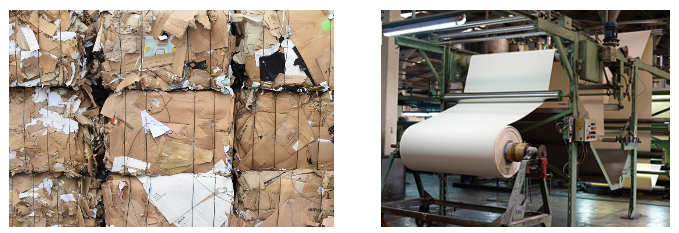
The cardboard bales are then transported to a paper recycling plant.
The recycling process then takes place in 3 phases:
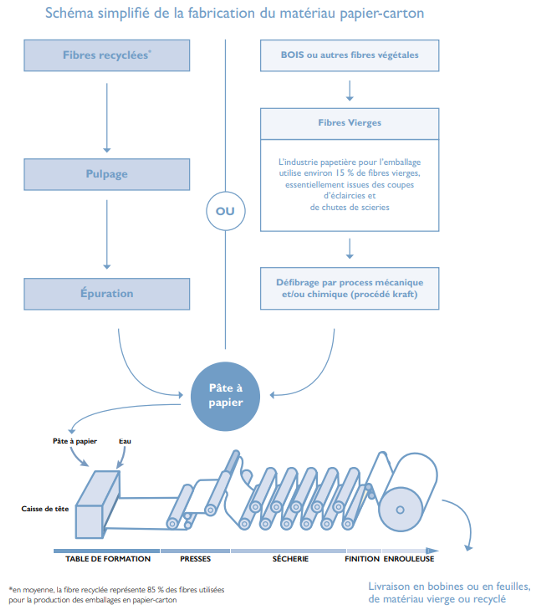
#1 Pulping and defibration: used paper and cardboard products are first placed in a pulper. This mixing in water breaks the bonds between the cellulose fibers and separates them from any residual products they may contain.
You would be surprised at the amount of hair and sand extracted during this stage.
#2 The classifier: this is the purification stage which separates the fibers from the elements associated with them: glues, varnishes, staples, etc.
#3 De-inking: this is only necessary for the manufacture of white pulp, and the process is mainly used in the case of recycling newspapers and magazines.
The fibers then rejoin the usual paper and cardboard manufacturing process. They are deposited on a moving screen, where they are drained to form a sheet, which is pressed and dried on cylinders heated with steam. A new sheet of paper or cardboard is then manufactured. A master reel is then produced: it is ready to go back to the factory to manufacture new cardboard boxes!
Some recommendations
So, which adhesives (or glues) and inks should be chosen to promote the recycling of paper and cardboard packaging?
Rule No. 1: prioritize classifiable and non-fragmentable adhesives, known as "level 1" (e.g. non-PSA hot melts). They are fully compatible with recycling, as they fragment into coarse pieces that are eliminated at the classifier level.
Rule No. 2: select water-dispersible adhesives. That is, glues that disperse in water, they are said to be water-soluble. Undesirable effects are possible, but they are limited by the implementation of adapted processes at the recyclers.
Rule No. 3: it is recommended to check with the glue supplier that their compositions do not contain mineral oils.
Conversely, fragmentable and water-insoluble adhesives should be avoided. This is the case with most pressure-sensitive adhesives (PSA). Being viscous, they generate persistent pieces in the process, called "stickies". They cause quality defects in recycled paper and increase the cost of machine maintenance and water treatment.
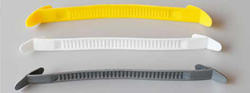
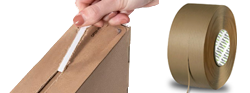
Brandstrom distributes, among other things, 100% paper Adhesive Stripping Tapes that are fully recyclable and repulpable, as well as recyclable and compostable reinforcement tapes.
With regard to inks, the first recommendation is to avoid inks based on added mineral oils, in order to prevent contamination of the packaging recycling loop by these substances. It should be noted that mineral oils contained in inks for all packaging have been prohibited since January 1, 2022. The second is to optimize the quantities of inks used.
The different recyclable cardboard logos
With so many logos on cardboard boxes, it is sometimes difficult to find your way around.
Some have a similar meaning, others are specific.
Let's look at the main logos to know:
- FSC (Forest Stewardship Council): this logo is an environmental certification and an international label. It guarantees that the cardboard has been produced in a legal forestry operation that respects the laws and indigenous populations. The operation concerned ensures the sustainable management of forests, respecting biological diversity and soils, in order to preserve them for the future.
- PEFC (Programme for the Endorsement of Forest Certification): this organization has a similar mission to that of the FSC. This international NGO certifies the sustainable management of forests in 55 countries around the world.
- Recycling signage or Info-Tri: this logo is specific to the French market. It is a rectangle with several boxes indicating how to recycle the packaging. It is particularly useful when the packaging is made of different materials and has an informative and incentive role. Its objective is to simplify sorting instructions to encourage the population to carry out this essential action.
- Tetra Pak: this blue logo is affixed to renewable and 100% recyclable packaging. It concerns cardboard food bricks. It also promotes the circular economy, resulting in low CO2 emissions.
- APUR (Association of Producers and Users of Recycled Paper and Cardboard). This logo indicates the percentage of recycled fibers used in the manufacture of the cardboard. The higher it is, the better.
- Ecolabel: This European logo indicates that the cardboard has been produced according to strict ecological specifications. The environmental impact at each stage of the product's life is low.
- NF Environnement: This is a standard concerning the quality of use and environmental impact of cardboard. As with Ecolabel, products bearing this logo have been subjected to precise specifications.
A short glossary of recycling
BIODEGRADABLE: A product that, when left abandoned, is broken down by bacteria or other biological agents. Cardboard is biodegradable, but this does not mean that cardboard can be thrown away in nature: some elements on the packaging may require special treatment. For example: staples. There is also a risk of pollution due to the glues or inks present on the packaging.
COLLECTION: All the operations that consist of removing waste and transporting it to a treatment site.
SUSTAINABLE DEVELOPMENT: An essential concept in today's society, aiming to find a balance between economic progress, environmental protection and social well-being. This concept is based on the idea of meeting the needs of the modern world without compromising the resources and opportunities of future generations.
ECO-CITIZENSHIP: An eco-citizen is aware of belonging to an environment that guarantees their existence, which implies rights and duties in relation to a territory, a country or a continent, for example.
ECO-DESIGN: Integration of environmental characteristics into the design of the product in order to improve its impact on the environment throughout its life cycle.
ECOLOGY: The science that studies the relationships between living beings and their environment. It aims to understand how organisms interact with each other and with their environment, as well as the effects of these interactions on the entire ecosystem.
CIRCULAR ECONOMY: An innovative economic model that aims to transform the way we produce, use and manage resources. Unlike the traditional linear economy, which consists of extracting, producing, consuming and discarding, the circular economy proposes a more sustainable and efficient approach.
The main objective of the circular economy is to minimize waste and maximize the use of resources by keeping them in the economic cycle for as long as possible. This involves rethinking product design, promoting reuse, repair and recycling, and promoting collaboration between industry players.
LANDFILLING OF WASTE: Refers to its storage in the ground. Depending on their polluting characteristics, waste is directed to different classes of final waste storage facilities (CSDU). Depending on the nature, quantity and treatment objectives, different processes are used: biological, chemical, physico-chemical treatments, membrane separations, concentration. Biogas is captured and flared or recovered by the production of heat, electricity or fuel. In a landfill center, waste is stored in cells of 2500 m² in area, surrounded by dikes to prevent runoff. It should be noted that sorting errors are also directed to the landfill center...
RCF (Recycled Cellulose Fibers): This new raw material from recycling will be consumed by paper mills to become cardboard, paper towels, newsprint, etc. This is the life cycle of paper.
INCINERATION OF WASTE: A technique of transformation by the action of fire. To incinerate means "to reduce to ashes". It is one of the techniques that can be used to produce electricity and/or heat (urban heating for example), but which can be a source of air pollution. In France in 2018, 126 incinerators of non-hazardous municipal waste burned an average of 14.5 million tonnes of waste per year.
OVERBAND: Used during sorting, it is a suspended magnetic waste separator, which thanks to a permanent magnet, makes it possible to recover ferrous metals present in products from selective collection.
ECOLOGICAL PRODUCT: A product that will minimize its impact on the environment during its life cycle. This means that the stages of the product's life cycle - which are its manufacture, packaging, transport, use and recycling - will respect the environment. In other words, selecting a product classified as ecological means choosing a product based on recycled elements that limits its impact on air, water or soil pollution.
ECO-RESPONSIBLE PRODUCT: There are several types.
- Compostable products are those which, once used, are recovered by an industrial unit which will be responsible for degrading them. This degradation will generate fertilizer.
- Recyclable products are those that are perfectly reintroduced into the production cycle. Examples include recycled cardboard or paper.
- Biodegradable products have the ability to be broken down by living organisms such as bacteria.
RECONDITIONING: Consists of involving a professional to restore an electronic or household appliance that has already been used to working order. These products benefit from the legal guarantee of conformity for a minimum period of six months.
RECYCLING: A process that consists of transforming waste into useful new products. The aim of this practice is to reduce waste and greenhouse gas emissions, preserve natural resources and ensure sustainable production.
Recycling is a complex process that involves the collection, sorting, cleaning, processing and sale of recycled products. This practice can be carried out on many types of waste, such as paper packaging, cans, plastic bottles, metals, batteries, tires and textiles.
Cardboard is recyclable if it does not contain any other elements, such as food scraps. It is therefore necessary to be careful when throwing away, for example, pizza boxes or fruit juice cartons. It is necessary to remove traces of food.
REUSE: This is the renewed use of waste for a purpose analogous to that of its first use. It is, in a way, extending the life of the product before it becomes waste. For example, the deposit on bottles, which are refilled after cleaning.
REPULPABLE: means that the product can undergo the fiber recovery process in the pulper: this mixing in water breaks the bonds between the cellulose fibers and separates them from any residual products they may contain.
REUTILIZATION: consists of using waste for a different purpose than its first use, or of making, from waste, a product other than the one that gave rise to it. For example, using car tires to protect the hulls of boats or trawlers.
RECOVERY RATE: this is the percentage ratio of the quantity of recovered products to the total quantity of sorted products.
SORTING: is an operation in which collected recyclable waste is gathered to be sorted by material. These materials are packaged in bales or in bulk to be resold to recyclers, without their physico-chemical characteristics being modified.
TROMMEL: during sorting, a rotating cylinder composed of perforated grids that separate materials according to their size.
UPCYCLING: This is a practice that consists of recovering materials or products that are no longer in use, in order to transform them into materials or products of superior quality or utility. It is therefore a recycling "from above." The notion of added value brought to the final product comes into play, unlike conventional recycling, for which the recycled product will a priori be of lower quality or, at most, equal to the original product. In interior decoration, for example, storage pallets are transformed into tables, armchairs or shelves.
RECOVERY: refers to any operation whose main result is:
- The use of waste that serves as a replacement for other materials that would otherwise have been used to produce the good or equipment concerned.
- Or the transformation of waste so that it can subsequently be integrated into a value chain for the purpose of producing future goods or equipment, in that production unit or in any other manufacturing process.
Sources:
- CEREC "Guide to assessing the recyclability of household packaging made from paper and cardboard - Eco-design for better recycling" June 2022 220610-brochure-cerec-lowdef.pdf
- PAPER, "The recycling process", http://www.lepapier.fr/procede_recyclage.htm
- The paper and cardboard packaging is then compacted and assembled into bales of approximately 1 tonne.
- LEMON TRI, "Cardboard recycling", https://lemontri.fr/le-recyclage-du-carton
- https://fr.wikipedia.org/wiki/Recyclage
- COFEPAC, "The paper-cardboard packaging industry - facts and figures", October 2022
Our products
Tear or reinforcement adhesive tapes

Double-sided adhesive tapes

PERSSON plastic or paper strap handles

FORMUS molded plastic handles
100% Paper Tear-Off Tape
Silicone Paper
We represent, among others, the following companies:
Bagla Group